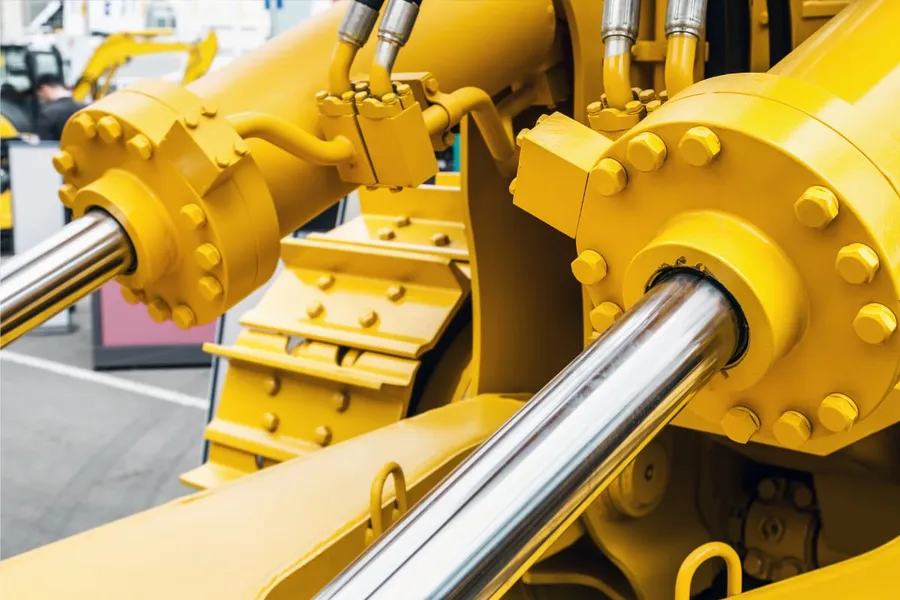
Hydraulics is the study of how fluids behave when they are in motion. This applies to the flow of fluids in pipes, rivers, and channels, as well as fluids stored in tanks or other containers. Understanding hydraulics helps cities keep water systems and sewage networks running smoothly. This understanding has also led to the invention of powerful machines that help accomplish various types of work.
Ancient civilizations learned how to use flowing water to perform tasks. Water was used to power mills and provide irrigation for farming. Later, people were able to use fluids more broadly after scientists discovered that all fluids follow certain rules. They learned that pressure in a fluid is transmitted equally in all directions. This means that when pressure is applied to a fluid in a tube, the fluid will push with force on any object in its path, even if that object is larger than the original tube. Therefore, it is possible to use a small amount of force to produce a greater force elsewhere.
In the nineteenth century, scientists were able to use their knowledge of fluids to develop systems that provide power for operating factory equipment. Since then, others have learned how to use fluid power in many machines. For example, modern aircraft and cars use hydraulic systems to operate brakes and steering mechanisms. Hydraulic systems are also used in industrial robots and large excavation equipment at construction sites. The fluid used is typically a type of oil, because light oil is better than water; it does not freeze, does not cause rust, and keeps moving parts lubricated.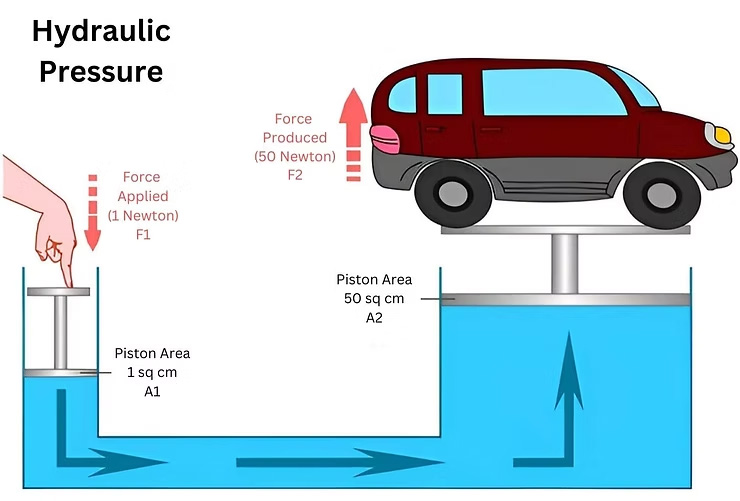
Hydraulic systems make it easier to move heavy objects. For example, car mechanics can use a small force to generate a greater force that lifts the car into the air. Source: rancholabs
Hydraulics has many wide-ranging applications in our lives. If you want to learn about hydraulics hands-on, try the BarqBoxes Hydraulic Arm box where you will build an arm that moves using water pressure. We also have the Exploring Hydraulics box that provides everything you need to build both a water worm and a scissor lift as hydraulics applications.
How Does a Hydraulic System Work?
Hydraulic systems are built and operated based on fundamental scientific principles known as "Pascal's Law" and "Bernoulli's Principle." Pascal's Law states that a change in pressure within an enclosed fluid is transmitted equally in all directions. When pressure is applied at one point in an incompressible fluid, that pressure is transmitted instantly to all other parts without any loss. This principle is considered the foundation of hydraulic systems, allowing machines to perform enormous tasks with ease and precision.
When applying this law to hydraulic systems in practice, the fluid (usually oil) flows from a region of high pressure to a region of low pressure, transferring energy during its movement. The pressurized fluid flows through a network of pipes, hoses, and valves to generate force and motion. This movement occurs when the pressurized fluid acts on a piston, pushing it up or down, which causes parts of the machine to move and perform a specific task.

Blaise Pascal was a French physicist, mathematician, and philosopher famous for his experiments with fluids in physics. Source: wikipedia.org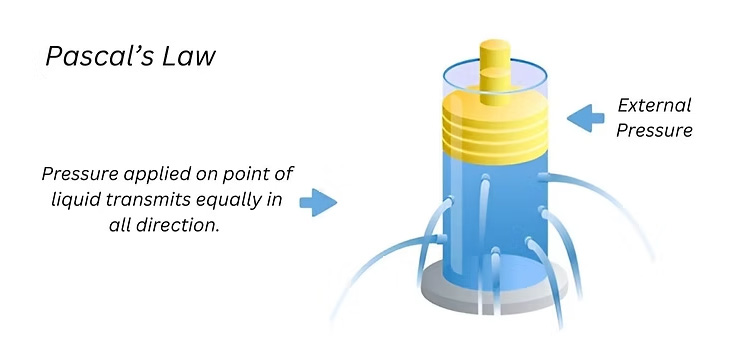
Bernoulli's Principle, established by Daniel Bernoulli in 1738, is one of the fundamental pillars of fluid mechanics and is closely related to the operation of hydraulic systems. This principle states that an increase in the speed of fluid flow is accompanied by a decrease in the fluid's pressure or potential energy. In simpler terms, the faster a fluid flows, the less pressure it exerts.
In hydraulic systems, this principle is essential for regulating the flow rate of hydraulic fluid. Modern hydraulic systems leverage Bernoulli's Principle to optimize pressure distribution and fluid flow speed within the system, ensuring operational efficiency and reducing energy loss.
Daniel Bernoulli was a Swiss mathematician and physicist of Dutch origin. Source: wikipedia.org