Levers are simple tools we use to lift or move heavy objects instead of relying solely on our muscle power. The first person to describe the principle of the lever was the Greek scientist Archimedes, who famously said: "Give me a fulcrum and I will move the Earth." It is said that the ancient Egyptians used levers to build the pyramids and lift giant stones, and scientists and engineers have used them ever since. Among the benefits of using levers is that they reduce the effort needed to move objects, increase the speed of completing tasks, and make work safer.
You may not notice it, but levers are everywhere around you and they make our lives much easier. When you use food tongs, you are using a lever. A seesaw in the park is a form of lever. Even the screwdriver you use to loosen screws is a type of lever.
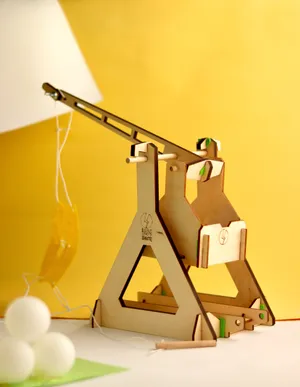
The lever arm is the most important part of how a catapult works. Join BarqBoxes fun educational boxes and learn more about this machine through the amazing Catapult box!
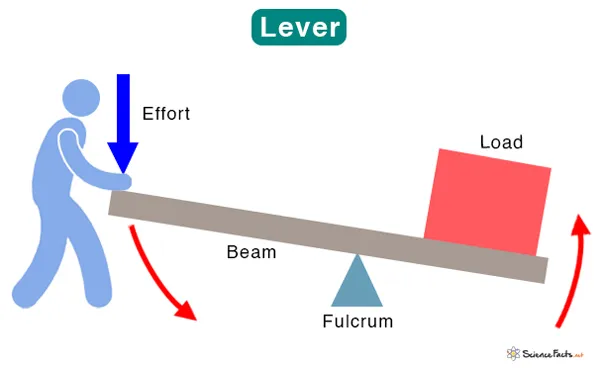
Did you also know that your own body contains levers? When you lift something with your arm, the joint (elbow) acts as the fulcrum, the muscles exert the effort, and the object you are lifting represents the resistance. Every lever consists of three main parts:
• The lever arm, which is the part that moves around the balance point. The lever arm is divided into the effort arm and the resistance arm.
• The fulcrum or balance point.
• The force or effort we exert to accomplish the task.
.jpg-bb6fb00c-f673-492f-a01e-71f2965dcda1.jpg)
With their simple design, levers make it easier for us to perform various tasks. Image credit: bbc.co.uk
Levers are divided into three main types based on the position of the fulcrum, effort, and resistance. Each type has its appropriate use depending on the task required. Let us learn about them with everyday examples:
• First class: The fulcrum is in the middle. In this type, the fulcrum is between the effort and the resistance. Examples include scissors and a seesaw.
• Second class: The resistance is in the middle. Here, the resistance (load) is between the fulcrum and the effort. Examples include a wheelbarrow and a nutcracker.
• Third class: The effort is in the middle. In this type, the effort is between the fulcrum and the resistance. Examples include tweezers and a shovel.
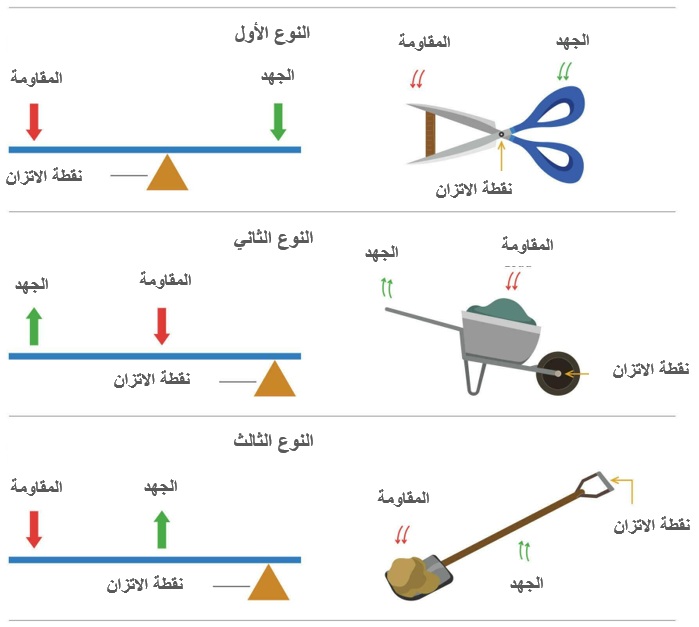
The three types of levers with examples. Image credit: vecteezy.com