After the fall of the Roman Empire in the fifth century CE, the average European's knowledge of the world was limited to their local area and maps provided by religious authorities. The great European discoveries of the 15th and 16th centuries would not have happened so quickly without the important work done by translators and geographers in the Islamic world.
The Islamic Empire began expanding beyond the Arabian Peninsula after the death of Prophet Muhammad ﺠ in 632 CE. Muslim leaders conquered Iran in 641, and by 642 Egypt was under Islamic control. By the eighth century, North Africa, the Iberian Peninsula (Spain and Portugal), India, and Indonesia had become Islamic territories.
Around 762 CE, Baghdad became the intellectual capital of the empire and issued a call for books from all over the world. Merchants were paid the weight of each book in gold. Over time, Baghdad amassed a wealth of knowledge, including many important geographical works from the Greeks and Romans. Among the earliest books translated was Ptolemy's "Almagest," a reference for the positions and movements of celestial bodies, and his "Geography," a description of the world and guide to places. These translations preserved the information in these books from being lost. Thanks to their vast libraries, the Islamic view of the world between 800 and 1400 was far more accurate than the Christian view of the world.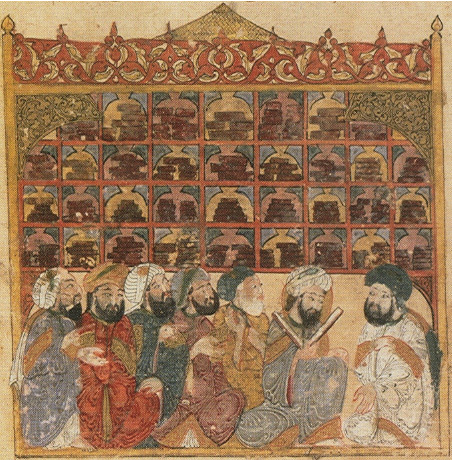
A thirteenth-century manuscript painted by al-Wasiti from the famous "Maqamat al-Hariri" by al-Hariri. The image shows a library in Baghdad. Source: Wikimedia Commons.
Islamic geography was a continuation of Greek and Roman geographical science, which had been lost in Christian Europe. However, Muslim geographers, especially al-Idrisi, Ibn Battuta, and Ibn Khaldun, added new contributions to the accumulated ancient geographical knowledge.
Al-Idrisi
Much is known about the life of al-Idrisi. He is believed to have been born in Ceuta, Morocco, around 1100 CE. Al-Idrisi is thought to be a descendant of the Prophet Muhammad ﺠ. He studied at the University of Cordoba in Andalusia and traveled throughout North Africa and the Mediterranean region of Europe and Spain.
In 1145 CE, al-Idrisi became an advisor to King Roger II of Sicily. Roger II employed al-Idrisi to create an updated world map. Al-Idrisi sent travelers and geographers to gather information from various parts of the world for this massive project.
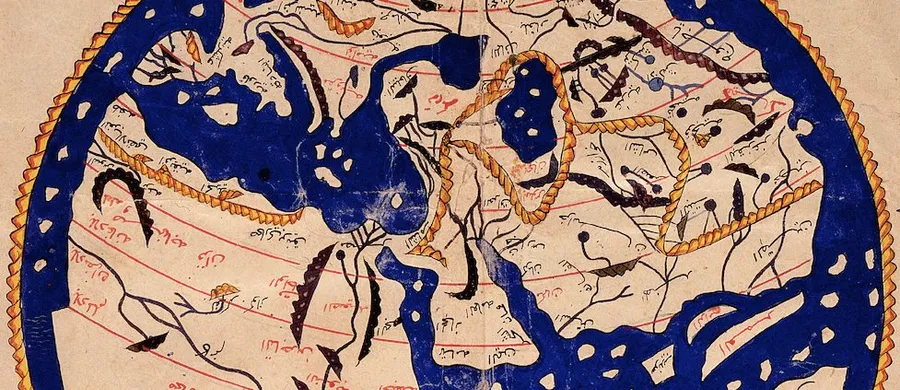
The fruit of these efforts was the book "Nuzhat al-Mushtaq fi Ikhtiraq al-Afaq" (The Pleasure of Him Who Longs to Cross the Horizons), completed in 1154 CE, shortly before the king's death. The work included a text explaining geographical discoveries and a collection of 70 maps covering regions of the world north of the equator. Al-Idrisi's work was translated into Latin and studied around the world.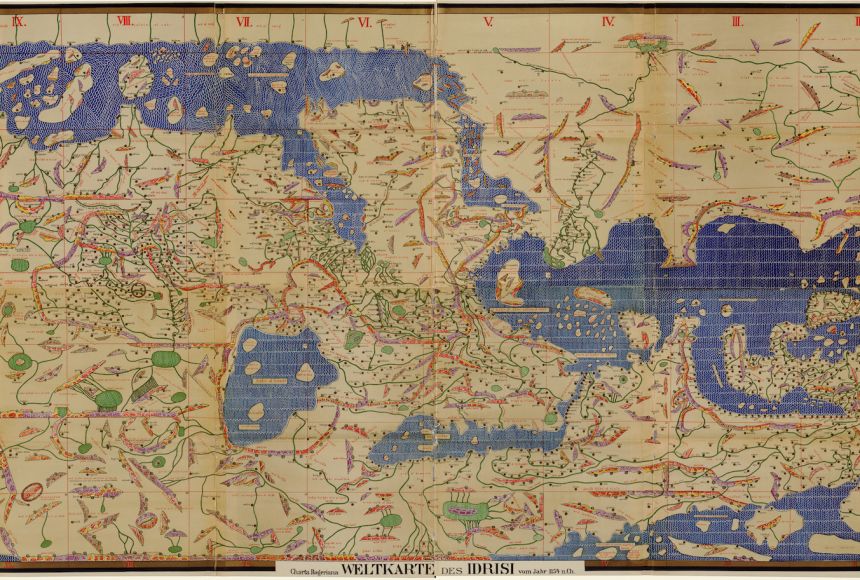
Al-Idrisi's map of the Mediterranean. The Arab geographer al-Idrisi oversaw the creation of more than 70 maps. This map shows the Mediterranean, North Africa, Europe, and parts of Asia. The map was oriented with south at the top. Photo: Buyenlarge/Getty Images
Geography is much more than random facts about oceans and forests! If you are curious to explore the world, you should join BarqBoxes' fun educational box about Geography. Discover BarqBoxes!
Ibn Battuta
Muhammad Ibn Battuta was born in 1304 CE in the Moroccan city of Tangier in North Africa. Most boys of that time and place would have received a basic education in writing, grammar, and basic mathematics until the age of twelve. However, since many members of Ibn Battuta's family were scholars and judges, he also received advanced studies in the Quran and law to become a judge.
From a young age, Ibn Battuta loved traveling and was interested in news of the world that he read about in books. He began his journeys at the age of twenty-one when he set out on the pilgrimage to Mecca in 1325 CE. But his journey did not stop at the pilgrimage alone; he continued traveling for over 30 years, during which he visited North Africa, Egypt, the Levant, the Hejaz, Iraq, Iran, East Africa (Somalia, Kenya...), Central Asia, India, China, Andalusia, and parts of sub-Saharan Africa (Mali). Over thirty years of travel, the explorer Ibn Battuta explored much of the Eastern Hemisphere and nearly the entire Islamic world. From every place he visited, he recounted his experiences and wrote about the people, places, animals, and treasures he saw or was given. In total, he traveled approximately 73,000 miles, visited around 40 countries, and crossed three continents between 1325 and 1352.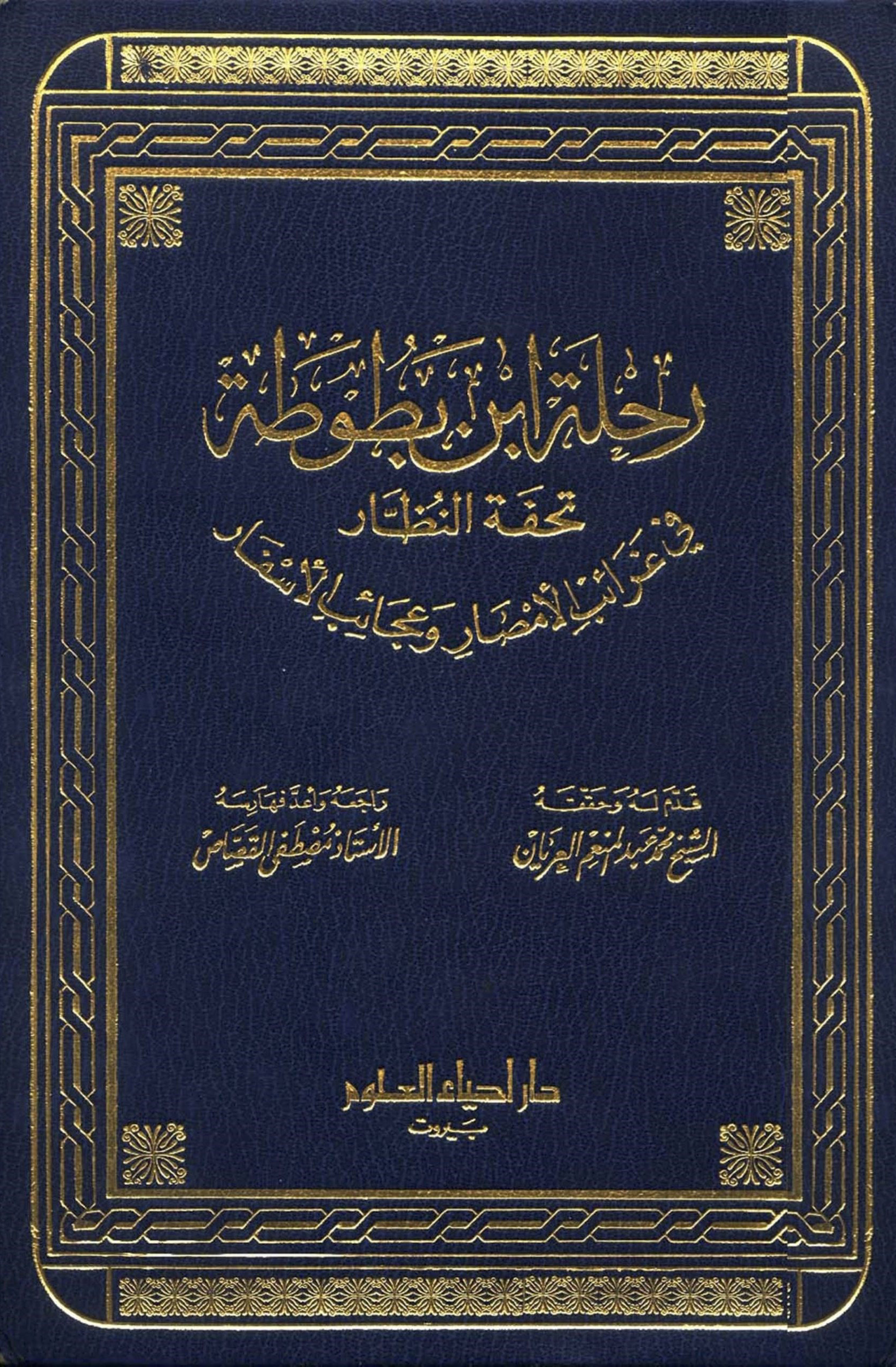
The book "Rihla" (The Travels of Ibn Battuta) is considered one of the most comprehensive and historically significant books in the world and has been translated into 40 living languages. In 1356, the Marinid ruler of Morocco asked a young literary scholar named Ibn Juzayy to record Ibn Battuta's experiences and observations, and Ibn Juzayy worked with Ibn Battuta for two years to compile the book "Rihla."
Al-Biruni
Al-Biruni has been described as among the greatest minds known to Islamic culture. He was an astronomer, mathematician, pharmacist, geographer, historian (polymath), and a distinguished traveler. Al-Biruni was characterized by a love of knowledge and traveling in search of science. As a young man, he learned various languages such as Arabic, Persian, Greek, Syriac, and Hindi. As a geographer, he was one of the greatest geographers of the Middle Ages and left a significant impact on the development of geography in the Islamic world and the world at large. Al-Biruni was one of the first scholars to formulate accurate hypotheses about the shape of the Earth and was able to provide a precise calculation of the Earth's circumference using an innovative mathematical method. Al-Biruni was interested in studying lines of latitude and longitude and used them to determine the locations of places on the Earth's surface. In his travels, Al-Biruni's interest was not limited to physical geography alone; he also studied human and cultural geography. 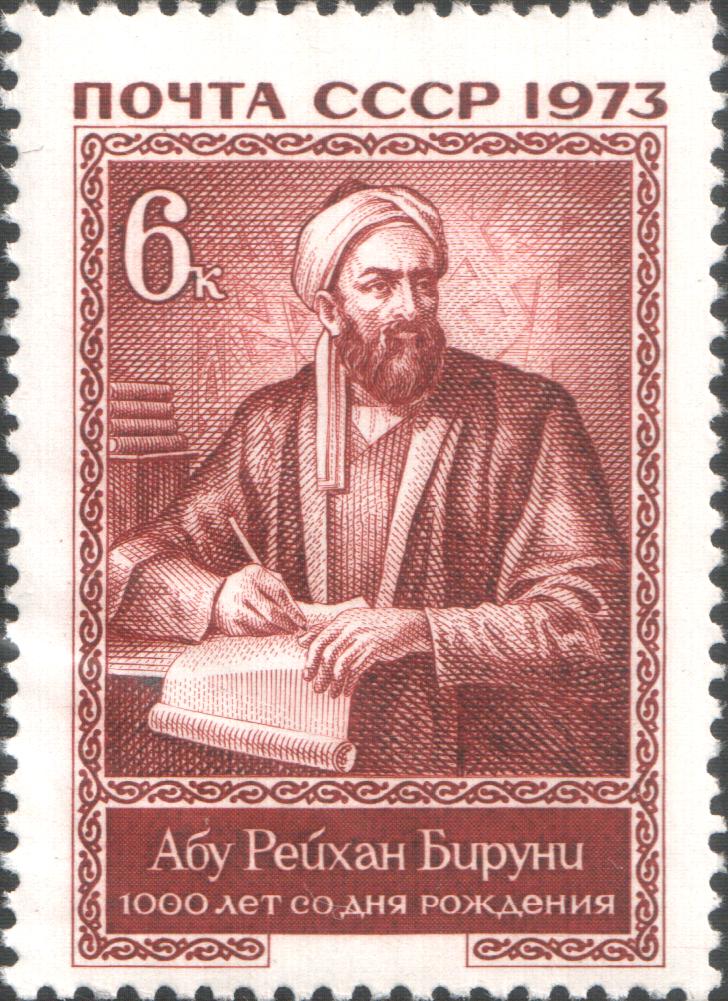
Fictional representation of Al-Biruni on a Soviet postage stamp from 1973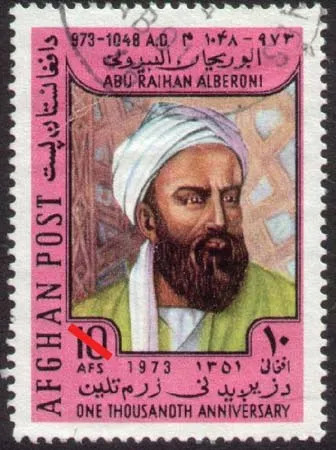
Al-Biruni. Afghan commemorative postage stamp, 1973.