.jpg-6814cc72-2084-4a4a-bb76-87b5c84b8b4b.jpg&w=900&format=webp)
When you look at the ornamental patterns in ancient mosques, you may notice that each part resembles the other in a beautiful and organized way. You may also notice a repetition of shapes where the pattern looks as if it were a reflection in a mirror or rotating around a central axis. These are all examples of symmetry in Islamic art. Islamic arts are a wonderful example of using mathematics and geometry in various applications. Symmetry plays an important role in Islamic art, carrying deep spiritual meanings that lead us to reflect on the greatness of the Creator and the beauty and order of the universe.
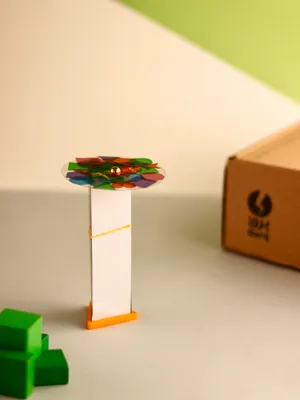
Have you heard of a Kaleidoscope before? It is a visual toy through which you can see symmetry
created by the reflection of colorful shapes on mirrors in a beautiful way! Join our fun educational boxes
to discover the Kaleidoscope box.
Why Did Islamic Art Focus on Symmetry?
Muslim artists excelled in using geometric shapes and plant-based motifs, and symmetry was a wonderful means to create stunning designs that combine repetition, beauty, and precision. Symmetry also reflects the idea that the world is precisely organized and that behind this order is a wise Creator. For this reason, Islamic designs are not merely beautiful drawings but visual messages about divine order and beauty.
.jpg-17f999cd-b39b-4d81-a257-523084644468.jpg)
The North Dome of Taj al-Mulk (with pentagonal ornaments), Jame Mosque, Isfahan, built in 1088 (Photo: R. Henry), alongside details showing the orbit of Venus from James Ferguson's book, Astronomy Explained Upon Sir Isaac Newton's Principles, 1799 edition, Plate 3, p. 67
Types of Symmetry in Islamic Art
Radial symmetry is one of the most common forms of symmetry in Islamic art. It consists of a central point surrounded by identical shapes or patterns extending outward in a circular or spiral formation. This type of symmetry can be seen in the intricate designs on mosque ceilings and walls.
.jpg-27089543-c3b5-4181-83e2-a82cb9a0a66b.jpg)
Radial symmetry is common in the interior decorations of mosques. Image credit: wikipedia.org
Bilateral symmetry is also a common form of symmetry in Islamic art, where a central axis divides the artwork into two perfectly identical halves. This type of symmetry can be observed in Islamic carpet designs as well as in architecture, where repeating geometric patterns are reflected on either side of the central axis.
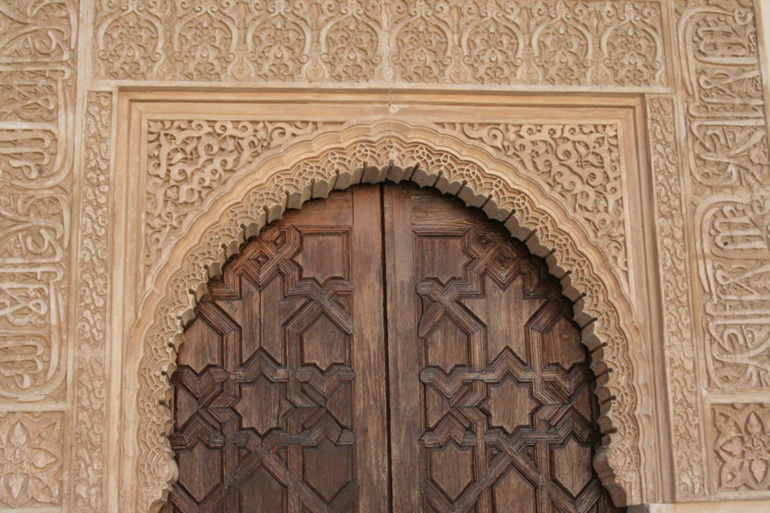
The geometric patterns in bilateral symmetry appear as if they are a reflection in a mirror placed along the center line. Image credit: artofislamicpattern.com
Where Do We Find Symmetry in Islamic Art?
Architecture includes many examples of symmetry in mosques, palaces, and Islamic gardens. We also find stunning examples of symmetry in Moroccan tilework (Zellige), where small colored pieces are assembled to create precise, repeating designs. Calligraphers use symmetry in writing Arabic phrases such as Quranic verses, hadiths, and proverbs in a repetitive or mirrored style. Another common example is the use of symmetrical geometric patterns in the manufacture of textiles and carpets.
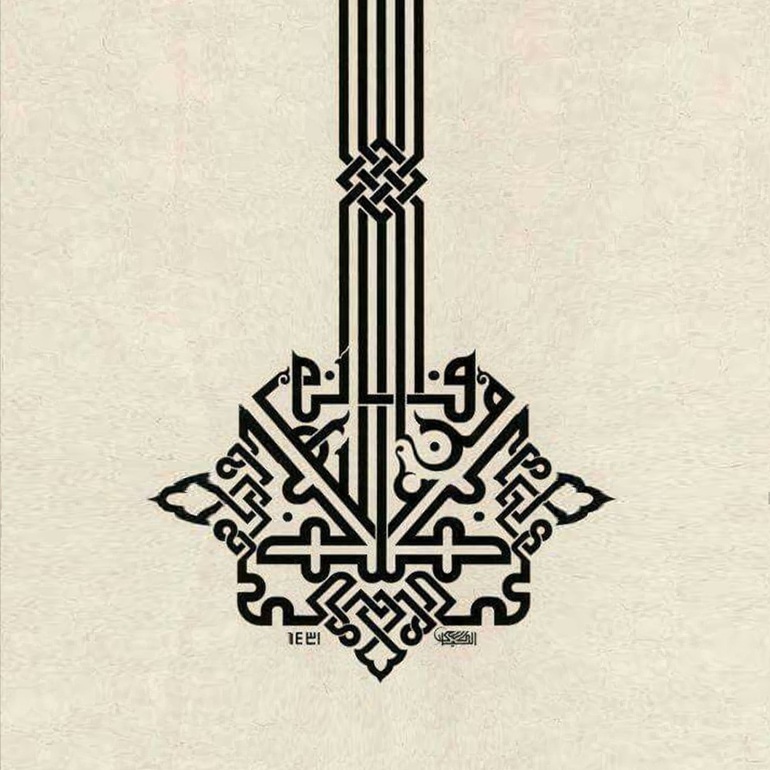
Arabic calligraphy was used to decorate mosques, palaces, manuscripts, and artistic artifacts. Image credit: tethkar-store.com
How Were These Symmetrical Designs Created?
Muslim artists did not draw randomly; they used mathematics and geometry to craft their designs. They often relied on circles at the beginning of each design, using a single circle or several overlapping circles. Many designs also began with a star from which smaller shapes branched out. It was also common to use squares and polygons to divide spaces with great precision. The artists relied on simple tools like rulers and compasses, yet they were able to produce works of art with remarkable visual harmony, precision, and beauty.